Building a Compliance Culture That Increases the Value of Your Cannabis Business
For years, cannabis compliance has been viewed as little more than a regulatory requirement, a necessary part of maintaining a license and avoiding costly violations. But as the cannabis industry continues to mature, that perspective is rapidly changing.
Today's cannabis operators face increasing regulatory scrutiny, tighter margins, greater competition, and more sophisticated investors. At the same time, businesses are preparing for expansion into new markets, potential mergers and acquisitions, federal reform, and higher operational standards like Good Manufacturing Practices (GMP) and Quality Management Systems (QMS). In this environment, compliance is no longer just about checking boxes, it's about building a resilient, scalable business.
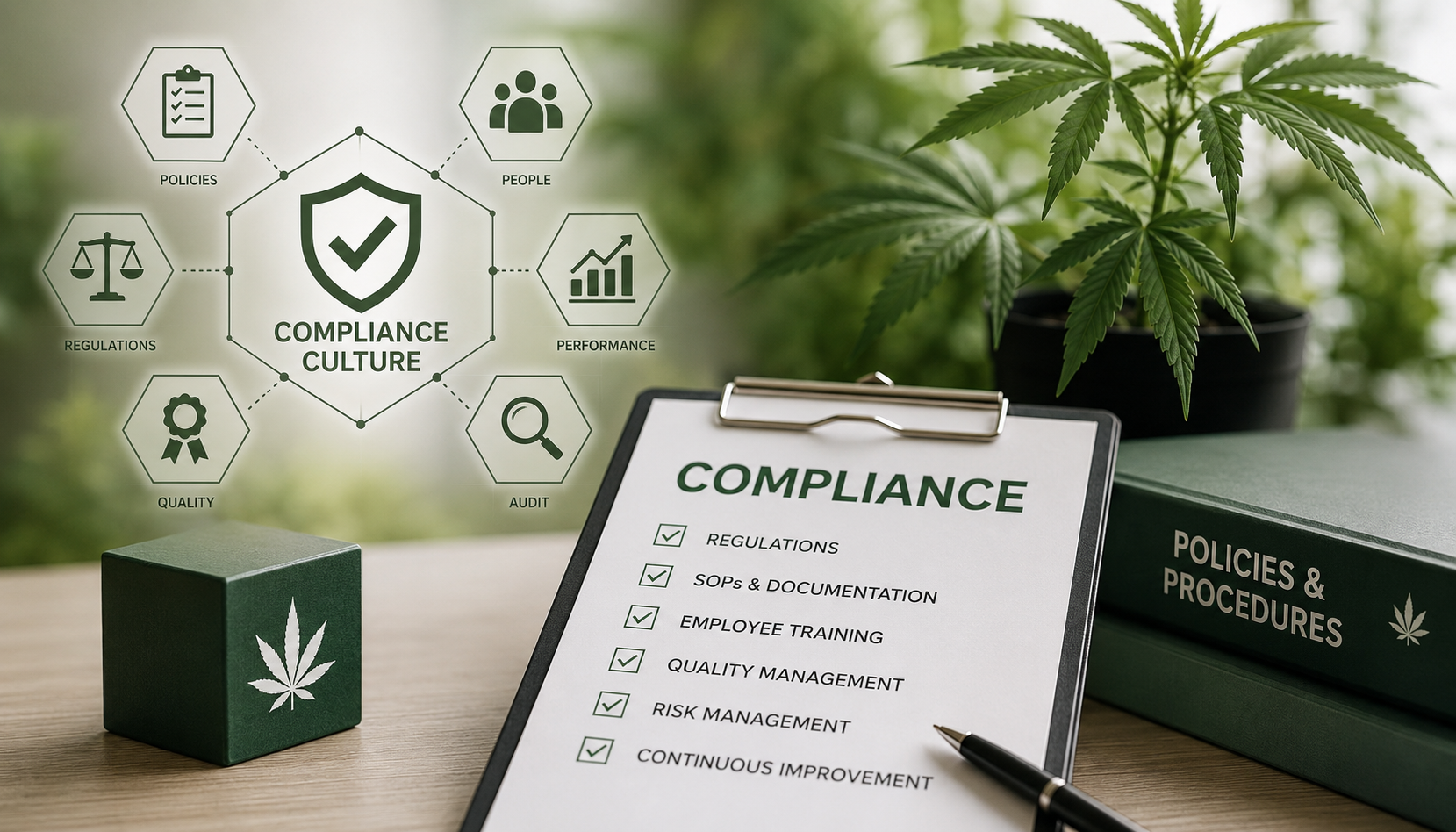
The most successful cannabis companies understand that compliance is more than a department or a single employee's responsibility. It is a culture that influences every decision, every process, and every employee throughout the organization. When compliance becomes part of your company's DNA, it reduces risk, improves operational efficiency, strengthens your reputation, and increases the overall value of your business.
If you're looking for a deeper dive into this topic, be sure to listen to episode 62: Building a Compliance Culture That Increases the Value of Your Cannabis Business, where I discuss why cannabis compliance has evolved from a regulatory requirement into one of the greatest drivers of business value in today's regulated cannabis industry.
Why Cannabis Compliance Is No Longer Just About Passing Inspections
Many operators still think compliance begins a few weeks before an inspection.
That mindset is costing businesses money.
A regulatory inspection only provides a snapshot of your operation on a single day. It does not evaluate how consistently your facility performs throughout the year.
Today's regulators, investors, banking partners, insurance providers, and potential buyers are evaluating something much larger:
Can your business consistently operate in compliance every single day?
That is where compliance culture becomes your competitive advantage.
What Is a Cannabis Compliance Culture?
A cannabis compliance culture exists when every employee from ownership to entry-level staff understands that compliance is everyone's responsibility.
Instead of reacting to problems, compliance becomes embedded into every operational decision.
Successful operators build systems that make compliance automatic rather than reactive.
A compliance culture includes:
- Written Standard Operating Procedures (SOPs)
- Ongoing employee compliance training
- Routine internal compliance audits
- Accurate inventory controls
- Strong document management
- Corrective and Preventive Action (CAPA) programs
- Leadership accountability
- Continuous operational improvement
Compliance becomes part of how the business operates not something reserved for inspection day.
Cannabis Compliance Creates Business Value
One of the biggest misconceptions in the cannabis industry is that compliance costs too much money.
But poor compliance actually costs significantly more.
Regulatory violations can result in:
- Monetary fines
- Product recalls
- License violations
- Suspensions
- Reputational risk
- Lost inventory
- Operational shutdowns
- Increased insurance costs
- Failed acquisitions
- Reduced business valuation
On the other hand, companies with mature compliance programs often experience:
- Greater operational efficiency
- Better employee accountability
- Fewer regulatory violations
- Increased investor confidence
- Higher business valuations
- Easier expansion into new markets
Compliance isn't simply risk management.
It's business development.
Five Best Practices for Building a Strong Cannabis Compliance Program
1. Develop Comprehensive Cannabis SOPs
Your Standard Operating Procedures should accurately reflect how your business actually operates, not simply satisfy regulatory requirements.
Effective SOPs create consistency, reduce employee mistakes, improve training, and strengthen regulatory compliance.
2. Conduct Routine Cannabis Compliance Audits
Waiting for regulators to identify compliance gaps is one of the most expensive mistakes operators make.
Routine internal compliance audits identify issues before they become violations.
A few examples of what a comprehensive cannabis compliance audit should review:
- Inventory reconciliation
- METRC accuracy
- Employee records
- Security compliance
- Packaging and labeling
- Waste management
- Record retention
- Operational procedures
- Facility documentation
- Overall compliance of operations
3. Build a Cannabis Quality Management System (QMS)
The industry's future is moving toward stronger quality systems.
A Quality Management System creates standardized processes for:
- Documentation
- Change control
- Training
- Internal auditing
- CAPAs
- Risk management
- Equipment maintenance
- Supplier management
As cannabis regulations evolve toward pharmaceutical and food-grade standards, QMS implementation will become increasingly valuable.
4. Prepare Today for GMP Compliance
Many operators assume Good Manufacturing Practices (GMP) only apply to pharmaceutical companies or companies involved in export/inport overseas.
That assumption is changing rapidly.
As cannabis markets mature, GMP principles are becoming an operational expectation particularly for manufacturers, processors, and companies pursuing national or international expansion.
Preparing early provides a significant competitive advantage.
5. Create a Continuous Compliance Mindset
The strongest cannabis businesses don't prepare for inspections.
They're always inspection-ready.
That means:
- Monthly internal reviews
- Annual compliance assessments
- Employee retraining
- SOP updates
- Management accountability
- Corrective action tracking
Continuous improvement creates stronger businesses.
Technology Is Transforming Cannabis Compliance
Modern cannabis businesses are replacing paper systems with digital compliance management.
Technology improves:
- Employee training documentation
- Inventory tracking
- METRC reconciliation
- SOP management
- Internal audit reporting
- CAPA tracking
- Equipment maintenance
- Quality management
- Regulatory documentation
Digital systems reduce human error while demonstrating operational maturity during inspections and due diligence.
Cannabis Compliance and Business Valuation
Whether you plan to sell your business next year or ten years from now, buyers increasingly evaluate operational risk before making an acquisition.
During due diligence they often examine:
- SOP documentation
- Employee training records
- Compliance history
- Quality systems
- Inventory controls
- Internal audits
- Regulatory correspondence
- Record retention
- Facility organization
A business with strong compliance systems is often viewed as lower risk and lower risk frequently translates into a higher valuation.
Preparing for the Future of Cannabis
The cannabis industry continues moving toward more standardized regulations.
Operators should begin preparing for:
- Federal legalization
- Interstate commerce
- GMP requirements
- GACP implementation
- FDA oversight
- Expanded quality management systems
- Enhanced recordkeeping
- Increased regulatory inspections
Businesses that invest in compliance today will be positioned to adapt more quickly as regulations continue to evolve.
How We Help Cannabis Businesses
At ICS Consulting, we partner with cannabis operators across the United States and internationally to build practical compliance systems that improve operations not just satisfy regulators.
Whether you're launching a new cannabis facility or improving an existing operation, our goal is to help you build a business that is organized, scalable, inspection-ready, and positioned for long-term success.
The cannabis companies that will lead the industry over the next decade won't simply be those with the best products.
They will be the companies with the strongest systems.
Compliance is no longer just about protecting your license.
It's about increasing efficiency, reducing risk, improving profitability, attracting investment, and maximizing the value of your cannabis business.
When compliance becomes part of your company culture, every aspect of your business becomes stronger.
If you'd like to learn more about cannabis compliance, cannabis operational excellence, and regulatory best practices, subscribe to Under the Microscope with Jenny or contact ICS Consulting to learn how we can help strengthen your operation.
ICS Consulting specializes in Compliance based services, such as Third-Party State Regulatory Audits, State and Local License Application Support, Technical Writing, Standard Operating Procedures Development, Worker Safety, QMS, OSHA Compliance, Metrc Seed-to-Sale Support, Compliance Operations Training, Employee Retention Solutions, and Employee Onboarding.
Learn more about ICS Consulting or book a call with Jenny Germano for additional resources and industry insights.